

Can Dogs Feel Jealous? What Science Says
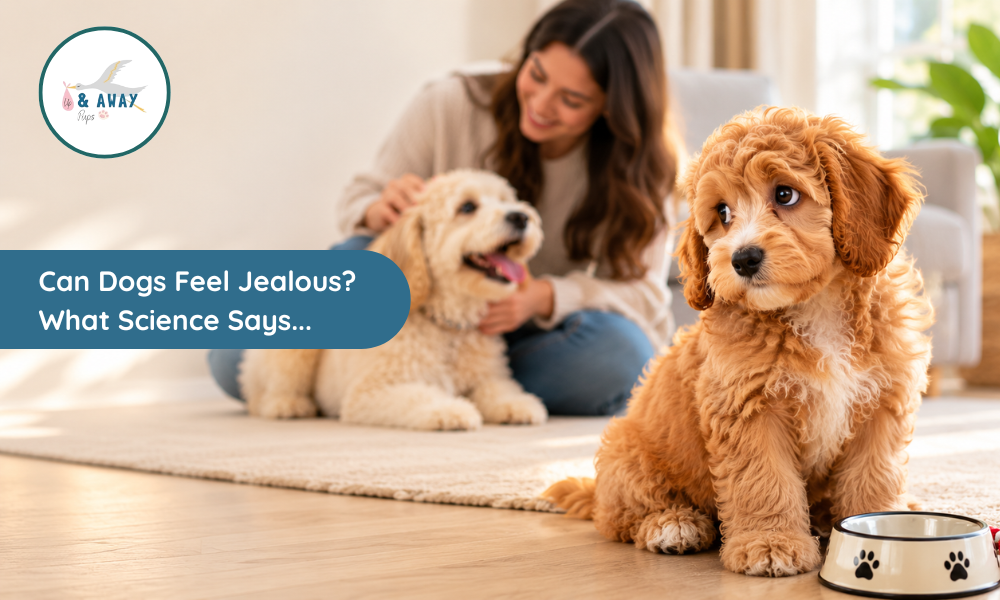
From competing for your attention to reacting to new pets or family members, dogs can display behaviors that resemble jealousy. Learn what scientific studies reveal, how to recognize the signs, and the best ways to respond.
For years, dog owners have insisted that their pets go jealous the moment attention shifts to another pet, a new baby, or even a phone. Scientists weren’t so sure. Jealousy was often considered a “complex” emotion. It was the one that required a level of self-awareness many researchers doubted dogs had.
That skepticism has faded pretty rapidly. Over the past couple of decades, only a handful of carefully designed studies have put dog jealousy to the test in ways that go far beyond anecdotes or hunches.
Here’s what research actually reveals. The debate still simmers among scientists, and the common signs are worth watching for in your own dog.
What Is Dog Jealousy, Really?
Jealousy is often categorized by researchers as a secondary emotion. They are more complex than anger or fear and are generally linked to safeguarding an important relationship against a perceived rival.
In humans, it shows up sooner, even in infants under a year old, right at the moment when a mother’s attention shifts to another baby.
Researchers have often wondered whether this strong bond between dogs and their owners, which is often similar to parent-child attachment, may produce the same reactions.
For instance, owners of small dog breeds, such as Teacup Yorkie puppies, often experience this close attachment sooner. This makes them aware of behaviors that appear protective when attention shifts elsewhere.
What Does the Science Actually Show?
Let’s get a closer look at the main findings behind dog jealousy based on facts.
The First Real Experiment Happened in 2014
Renowned psychologist Christine Harris and her team ran what was considered the first test for dog jealousy. The results were published in PLOS ONE. Owners are often asked to ignore their dogs while they pay attention to three primary things, such as:
- A stuffed dog that had barked and wagged its tail
- A plastic jack-o’-lantern
- A pop-up book that played music
About three-quarters of the dogs have pushed against their owner, who tried to squeeze between the owner and the fake dog. Or owners who have snapped it far more than they would have done towards a book or a pumpkin.
Dogs React Far More to Rivals Than to Random Objects
Research conducted later had repeated this test, implementing social and non-social test partners.
This includes:
- Familiar dogs
- Unfamiliar dogs
- Familiar objects
- Unfamiliar objects
Dogs often pushed, barked, or tried to interrupt whenever their owner focused on any other dog. However, they rarely behaved in the same manner when attention was on an object. This response was specifically linked to another creature who enters this social picture.
A similar type of behavior is also common across Miniature Schnauzer puppies. However, their temperament, individual personality, and socialization influence how strongly a pup would respond.
Dogs Don't Even Need to See the Rival to React
A study published in “Psychological Science” found that dogs keenly watch their owner interact with a realistic fake dog under two conditions:
- A complete view of the interaction
- Hidden behind a screen
Dogs continue to show jealous behavior even when the interaction is hidden. This suggested that they could imagine what was happening on the other end of the screen.
The Bond May Work Like a Parent-Child Relationship
Another study in Scientific Reports had compared the dog-owner bond to infant-mother attachments. Dogs showed more owner-specific, “get in the middle” behavior when their owners engaged with:
- Another dog, versus
- An inanimate object
Such patterns often resemble how a toddler reacts to a parent’s divided attention. It’s a part of why researchers today treat dog jealousy as a legitimate scope of study. Positive experiences during a puppy’s first visit to a dog park also strengthen their confidence around other dogs. This helps them build healthier social skills from an early age.
It May Be a Primal Emotion, Not a Complicated One
For a long time, scientists have assumed that jealousy requires complex self-awareness. However, dogs without human-led cognition continue to reveal identifiable jealous traits.
This suggests that emotion might be simpler and older than once thought, and more advanced than once thought.
Researchers explain this as a survival tool that helps protect an essential relationship from a rival, rather than as proof of humanlike introspection.
Scientists Still Debate the Word "Jealousy" Itself
Not all will agree on the label. A few researchers argue over the behavior as it reflects:
- Simple frustration
- Resource guarding
- Plain attention-seeking
However, the debate continues today, as behavioral evidence shows that dogs consistently favor “rival-directed” actions over general attention-seeking. This has shifted the conversation toward jealousy.
Questions such as “Why do puppies dig on beds?” also remind owners that most behaviors have different underlying causes. So, context matters before making assumptions about jealousy.
Signs Your Dog Might Be Feeling Jealous
Do you wonder if your own dog shows that type of behavior?
Signs to watch for:
- Nudging or pushing between you and another individual or animal
- Barking, whining, or growling when you show attention elsewhere
- Nipping or snapping at the “rival,” pet or stuffed toy alike
- Sudden clinginess or following you more closely than usual
- Attempts to physically block access to you
Occasional signs such as these are normal. Intense or frequent reactions mainly involving aggression are important to address sooner. Therefore, dog owners should learn ways to reduce separation anxiety in pups to reduce attention-seeking behaviors that are sometimes mistaken for jealousy.
What To Do If Your Dog Seems Jealous
There are a couple of logical steps that can help:
- Focusing on the “rival” and your dog together instead of one at a time
- Avoid punishing jealous behavior, as it increases anxiety instead of reducing it
- Building positive associations by pairing the rival’s presence with praises or treats
- Keep one-on-one time with your dog consistent so that attention does not appear scarce
- Consult a vet or certified behaviorist if reactions involve aggression or escalate
It’s important to follow a daily routine to keep your pup happy and give younger dogs meaningful attention and activity. This helps to reduce stress-based behaviors gradually.
Conclusion
The science on dog jealousy has moved a long way from pure speculation. Controlled studies now show that dogs react specifically to rivals for their owner's attention, sometimes even when they can't see the interaction at all. Whether or not researchers ever fully agree on the label, the behavior itself is real, a useful reminder that dogs' inner lives may be richer than they get credit for.
Frequently Asked Questions
Do dogs really feel jealousy, or is it just attention-seeking?
Studies show that dogs react specifically to rivals getting attention, not just to attention in general, which supports genuine jealousy rather than simple attention-seeking.
Which dogs were used in the first jealousy study?
The UC San Diego study tested 36 dogs, mostly smaller breeds, though later research found similar behavior across breeds of all sizes.
Can dogs be jealous of a new baby or partner?
Anecdotally, yes, and it fits the same pattern seen with rival pets or objects, though this exact scenario hasn't been tested in a formal study.