

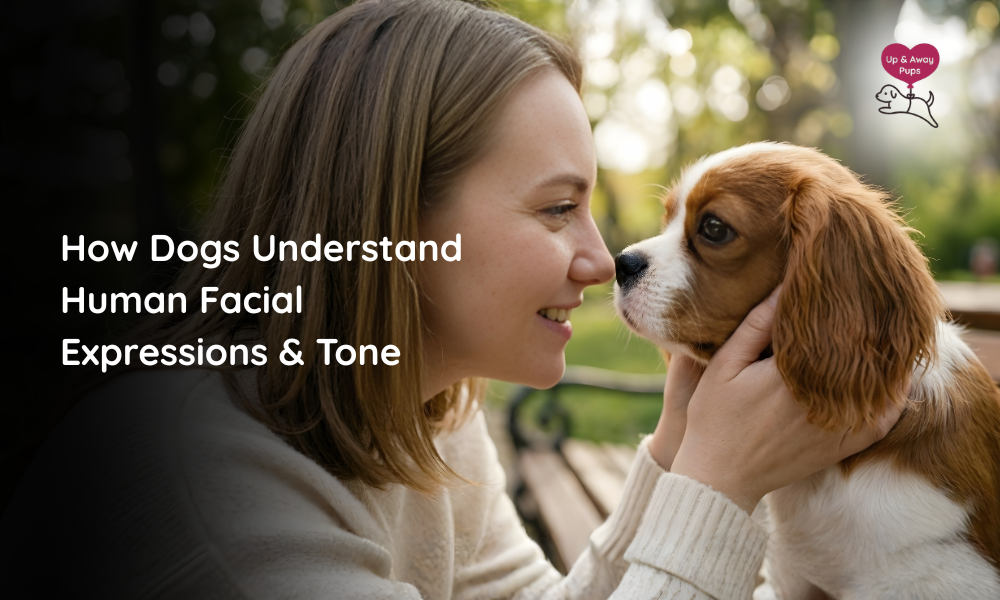
How Dogs Understand Human Facial Expressions & Tone
🐾 Table of Contents
The human-dog bond is so very deep and undocumented and founded on little gestures, emotions, and insights. Dogs cannot think: they respond to our smiles and frowns, our tone of voice, even more surprisingly correctly. This ability is not by chance; rather, it is anchored on evolution, observation, and emotional intelligence that have been gained over thousands of years.
To explore the depth of interpretations of facial expressions and tone in dogs, one needs to learn the fundamentals of canine communication and cognition.
The Evolution of Human–Dog Communication
The process of dog evolution has a history of over 15,000 years, together with man. Meanwhile, they were taught to understand human interaction as a survival game.
Domesticated animals that were able to understand the human motive, whether unfavorable or threatening, had more opportunities to survive previously. Over generations, this led to:
- Increased responsiveness of feeling human signals
- Better emotional awareness
- Greater attachment behaviors
In comparison, unlike wolves, dogs are friendly, want our attention and direction, and are genetically programmed, hence, to react to our facial expressions and tones.
Canine Brain and Emotional Intelligence
The brain of a dog is built to process social stimuli, similar to that of a human toddler. Studies indicate that dogs, especially small dog breeds like a Cavalier King Charles Spaniel, interpret the emotional cues through both sides of the brain.
Key abilities include:
- Recognizing emotional tone in voices
- Differentiating between happy and angry expressions
- Associating facial cues with outcomes
Dogs do not think or feel in the human way, but they are very adept at interpreting patterns and reacting accordingly.
Different Ways Dogs Read Human Facial Expressions & Tone
Dogs are highly sensitive to our facial expressions. At least to our mouths and eyes. They assess mood and intention based upon such visual cues.
Eye Contact and Gaze Interpretation
The dogs pay close attention to a human's eye movements and gaze direction to interpret attention, intention, and emotional state. Constant eye contact can be an indicator of affection or power, and avoidance can be viewed as a sign of discomfort; as such, it can help dogs modify their behavior in response.
This level of visual focus helps pups interpret the gentle emotional intent through:
- Direct eye signals
- Avoidance cues meaning
- Soft gaze comfort
- Staring threat perception
The dogs are very dependent on eye contact to understand trust and intention, which helps them respond differently. Regular eye contact aids bonding, training, and understanding emotions as time goes by.
Mouth Movements and Smiles
Using the shape and motility of the mouth as an important judge of expression, dogs monitor the mouth of a human. Smiles are known to indicate friendliness, and tense lips or exposed teeth can signal stress or negativity to dogs.
These are mouth signals to decipher emotional meaning:
- Relaxed mouth comfort
- Smiling equals safety
- Tight-lipped tension
- Teeth display a warning
Dogs can use their mouth movements to think of previous results. Smiles and positive reinforcement build trust, whereas negative expressions build suspicion or worry into conversations.
Tone of Voice Recognition
Dogs are extremely sensitive to tone of voice, and they are mostly concerned with what you say rather than what you are saying. They also differentiate happy, neutral, and angry tones with changes in behavior depending on the perceived emotional stimulus.
Various tones have varied reactions in the dogs:
- High-pitched excitement
- Calm tone reassurance
- Harsh tone warning
- Loud voice fear
Clear communication needs a consistent tone. Vocal patterns and outcomes are easily learnt by dogs, which makes them respond to orders and act accordingly.
Facial Tension and Emotional Signals
Dogs can pick up on subtle muscle shifts in the body, including tension in the eyes or forehead, to determine emotional states. The slight changes in these micro-expressions can be used to indicate stress, anger, or relaxation.
These little details add up to their perception:
- Tight eyes stress
- Furrowed brows concern
- Relaxed face calm
- Jaw tension alert
Dogs can read facial tension and predict human actions, and change their behavior. This skill increases their responsiveness and helps them avoid negative experiences or find solace when necessary.
Voice and Expression Alignment
Dogs never follow a single signal; they match facial expression to the tone of voice to be consistent. The same signal means the same thing, but non-matching signals do not help the dogs understand what to do, or can result in vague actions.
With combined processing, a better understanding is enhanced:
- Matching cues clarity
- Mixed signals confusion
- Tone-face consistency
- The significance of emotional agreement
Dogs rely on congruent signals to read intent correctly. Modifying tones and expressions with a match enhances conversational flow, minimizes tension, and enables dogs to react with self-assurance and predictability in daily interpersonal communication.
Conclusion
Dogs have the amazing capacity to read human facial expressions and changes in vocal tone, which have been developed through thousands of years of human companionship. What your dog thinks of you is not only interesting to discover but a necessity to establish trust, enhance training, and consolidate your relationship.
Once your dog pays concentrated attention to you and you communicate according to your routine, your dog listens and appreciates what you do.